

Why Christ keeps coming up in the “direct admission” conversation
Christ University’s BBA programmes sit near the top of most India Today and NIRF-adjacent rankings for private management education in Karnataka, and the university has built its undergraduate brand specifically around a rigorous, multi-stage selection process rather than board-marks-only entry. That reputation is precisely what makes it a magnet for admission consultancies promising shortcuts. Christ University is ranked first for BCA and fourth for BBA courses by India Today, which is the kind of credential that drives demand far past the number of seats actually available, and demand imbalance is exactly the gap that quota-selling intermediaries try to fill.
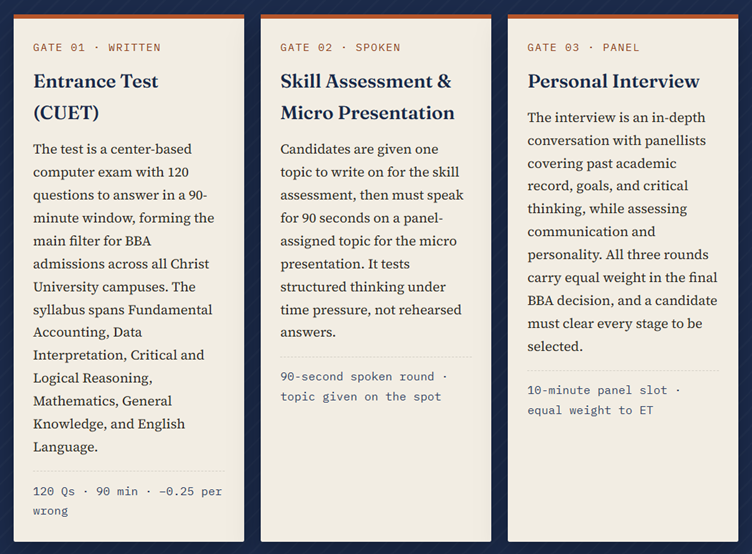
The honest starting point for any applicant is this: there is no official provision for direct admission to the BBA programme at Christ University, with admission decided solely through the Christ University Entrance Test followed by a Micro Presentation and Personal Interview. Any website or consultant offering to skip that sequence is not describing a Christ University process — they are describing something else, and the difference matters financially and legally.

The three gates, in order
Unlike colleges where a single cutoff score determines admission, Christ University evaluates a candidate three times, using three different instruments, and a weak showing in any one round can end an application regardless of strength in the others.
Gate One, Two, Three — No Shortcuts Between Them
Each gate tests something the others cannot. A high entrance score does not excuse a weak interview; a confident interview does not compensate for missing the entrance cutoff. All three must be cleared in sequence.
When the gates actually open in 2026
Christ University runs its entrance process in multiple sessions across the admission cycle rather than a single national-style exam date, which is part of why “direct admission” rumours persist — families who miss one session assume the door has closed, when in fact later sessions are usually still open until seats fill.
2026–27 admission cycle, by stage
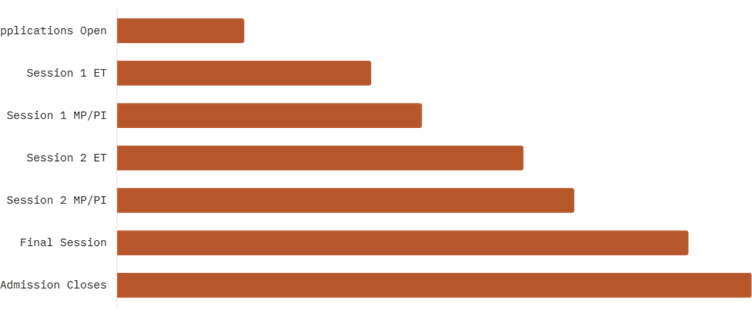
Registration for later sessions has continued well into the year, with Delhi NCR campus registration closing June 11, 2026, and the Bangalore Kengeri campus closing June 7, 2026, for that session, which confirms the multi-session structure: campuses run their own staggered windows rather than one fixed all-India date. Micro Presentation rounds have similarly been run in stages, with the first session held in December 2025 and the second in April 2026. Applicants targeting 2026–27 entry should treat the “last date” they see online as campus-and session-specific, not universal, and confirm directly against the campus they are applying to.
How and When Christ University Declares BBA Results in 2026
Because CUET runs across multiple sessions, “the result” isn’t a single date the way it might be for a national entrance exam — it’s a sequence of result points tied to each session.
➥ Step 1 — CUET scorecard: After each session’s entrance test, scores are released on the official Christ University admissions portal, generally within one to two weeks of the test date, depending on the session. You’ll need your application number and date of birth (or similar login credentials set during registration) to access your scorecard.
➥ Step 2 — Shortlisting for the next round: Based on your CUET performance relative to the cutoff for your chosen programme and campus, you’ll either be shortlisted to proceed to the Skill Assessment Test, Micro Presentation, and Personal Interview, or informed that you haven’t cleared this stage. Shortlisting communications are typically sent via email/SMS as well as posted on the portal.
➥ Step 3 — MP and PI scheduling: Shortlisted candidates receive a scheduled date, time slot, and mode (online or at a designated centre) for their micro presentation and interview.
➥ Step 4 — Final merit list and offer: After the interview round, the university compiles a composite score and releases the final selection list. Selected candidates receive an admission offer along with instructions for fee payment and document submission to confirm their seat.
Because Christ University runs rolling sessions, if you don’t clear cutoffs in an earlier session, you may still have time to register for a later session in the same admission cycle — this is one of the genuine advantages of the multi-session format over a single fixed-date exam.
A practical tip: keep your registered email and phone number active and checked regularly throughout the admission cycle, since most of the time-sensitive communication (shortlisting notices, interview slots, document deadlines) comes through these channels rather than requiring you to repeatedly check the portal manually.
📞 Call us at: +9742479101 | 🌐 Email: theace1guru@gmail.com | 📩 Website: bba-admission.com
Expert Management Quota Counselling | Personalized guidance | End-to-end admission support
What a BBA seat at Christ actually costs
Fee figures are the second most distorted part of the Christ University admissions conversation. Quota-selling sites routinely quote inflated “management quota” fee ranges to make their service fee look small by comparison. The university’s own published fee structure tells a different story.
Published BBA fee bands, Karnataka vs. non-Karnataka domicile
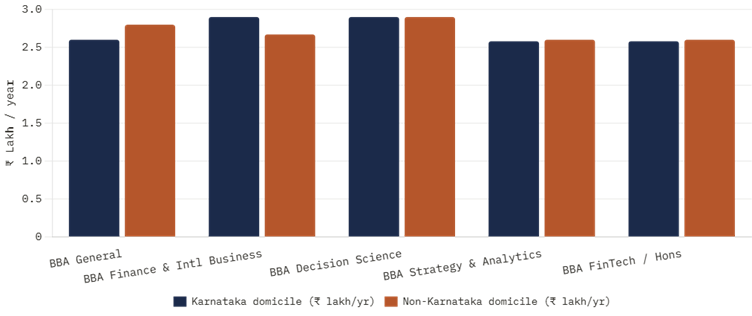
Christ University’s BBA programmes carry published fees ranging from roughly ₹2.55 lakh to ₹2.90 lakh per year, with Karnataka-domicile students paying around ₹2.60 lakh for most specialisations except BBA Decision Science at ₹2.90 lakh, while non-Karnataka students generally pay around ₹2.80 lakh, with BBA Finance and International Business or Strategy and Business Analytics tracking close to ₹2.90 lakh and ₹2.55–2.60 lakh respectively. These are official, FRC-adjacent figures published by the institution itself — not third-party estimates.
Compare that against what management-quota brokers advertise: third-party consultancy sites have quoted “management quota” fees for the BBA programme ranging from roughly ₹4.5 lakh to ₹7 lakh per annum or more, on top of which they note candidates “may have to pay a donation or capitation fee” as a separate one-time payment. That gap — roughly ₹2 lakh to ₹4.5 lakh a year above the published rate — is not a university charge. It is the markup a broker adds for “facilitating” a process that has no official paid fast-track to facilitate.
What the degree is worth on the other side
The placement conversation is where Christ University’s reputation is, on balance, better supported by data than its admissions-process reputation is misrepresented.
BBA cohort outcomes, recent placement cycle
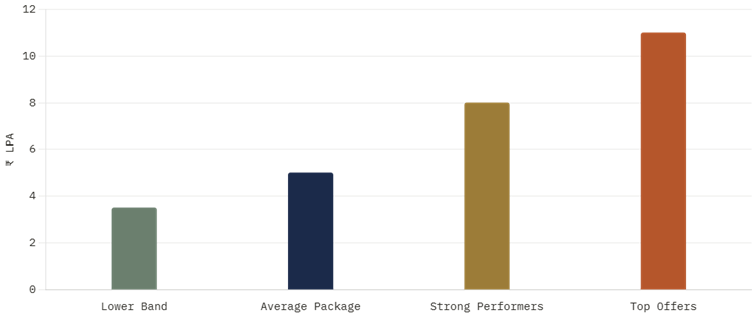
Christ University’s BBA cohort has typically seen average packages in the ₹4–6 LPA range, with top performers receiving offers above ₹10–12 LPA. That spread is fairly normal for a strong private BBA programme: the median outcome is solid rather than spectacular, and the upper tail — consulting, analytics, and BFSI roles — pulls the headline numbers up. Applicants and parents comparing “cost per placement outcome” should anchor on the median band, not the highlight package quoted in a brochure.
NRI and international-track applicants
NRI and OCI applicants are a recurring target for “quota” pitches specifically because international documentation genuinely is more complex, which gives bad-faith agents room to claim they are “handling paperwork” rather than buying a seat. Christ University’s own framing is that a management or NRI category may exist under institutional norms, but eligibility and verification remain mandatory through official channels only — in other words, an NRI applicant still sits the same entrance test, micro presentation, and interview; what changes is the supporting documentation (passport, visa status, equivalence certificates for foreign boards), not the selection bar.
Families routing an NRI application through a paid agent should ask one direct question before paying anything: does this service end at document preparation, or does it claim to influence the interview panel’s decision? The first is a legitimate, fee-for-service offering. The second is not something any legitimate agent can deliver, because the panel’s decision is not transactional.
How the gate compares to peer BBA entrance routes
Applicants weighing Christ against other top private BBA destinations — NMIMS (NPAT), Symbiosis (SET), Christ’s own past comparisons in counselling forums — tend to find the same three-part shape repeating: written test, communication assessment, interview. Christ’s specific weighting (equal weight across all three stages) is what differentiates it most.
| Component | Christ University (CUET) | Typical Peer Process |
| Written test weight | An equal third of the decision | Often, 50–70% of the decision |
| Spoken component | 90-second Micro Presentation | Group discussion (where used) |
| Interview format | Individual panel, equal weight | Individual or panel, often secondary |
| Negative marking | −0.25 per wrong answer | Varies by institute |
| Sessions per cycle | Multiple, campus-staggered | Usually a single national date |
The practical implication: a Christ applicant cannot “math their way in” by over-preparing only for the written test the way they might for a process where the entrance score dominates. Communication coaching and interview preparation carry genuinely proportional weight here, which is unusual enough that it is worth budgeting real preparation time for, not just question-bank practice.
📞 Call us at: +9742479101 | 🌐 Email: theace1guru@gmail.com | 📩 Website: bba-admission.com
Expert Management Quota Counselling | Personalized guidance | End-to-end admission support
What actually improves your odds, in order of impact
Stripped of the quota mythology, the controllable levers for a 2026–27 applicant are narrow but real. The entrance test rewards strong English and logical reasoning preparation specifically, alongside steady accuracy under negative marking, so targeted weak-area practice in those two sections tends to move scores more than broad revision. Because the paper mixes subjects unpredictably rather than grouping them by section, with roughly 45 seconds available per question, timed full-length mocks matter more than topic-isolated drilling.
For the Micro Presentation, the highest-leverage preparation is uneventful: practising fluent, structured 90-second answers on unfamiliar current-affairs and opinion topics, recorded and timed, so the format itself stops being the source of nerves on the day. For the interview, panels are explicitly assessing critical thinking and communication alongside academic record — which means a candidate’s ability to discuss their own choices (subject combination, why BBA, why this specialisation) coherently usually outperforms memorised “ideal answers.”
Direct answers to the questions families actually ask
✅ Is there really no direct admission or management quota for BBA at Christ University?
Correct. Every BBA seat is allocated only after clearing the entrance test, micro presentation, and personal interview. There is no separate paid quota category that bypasses this sequence.
✅ What does the BBA actually cost per year, officially?
Published tuition runs roughly ₹2.55–2.90 lakh per year depending on specialisation and domicile, before hostel and mess charges. Anything quoted significantly above that range, especially as a separate cash payment, is not an official university fee.
✅ Can I apply with only Class 10 and 11 marks if my Class 12 results aren’t out yet?
Provisional applications based on earlier academic records are commonly accepted pending final board results, but final admission confirmation still depends on meeting the minimum Class 12 eligibility once results are declared.
✅ How many admission sessions run in a year, and have I missed them all?
Christ runs multiple sessions across campuses rather than one fixed date, and registration windows have continued into June for some campuses in the current cycle. Check your specific target campus’s live portal before assuming you have missed the deadline.
✅ Does a weak entrance score get compensated by a strong interview?
No. All three stages carry equal weight and a candidate must clear each one; strength in one round does not offset a clear miss in another.
✅ Is the NRI quota a separate, easier admission route?
No. NRI and OCI applicants go through the same entrance test, presentation, and interview; what differs is the supporting documentation required for eligibility and verification, not the selection bar itself.
Choosing a track inside the BBA umbrella
“BBA at Christ” is not one programme but a cluster of specialisations sitting under the same admissions gate, and the choice between them matters more than most applicants realise at the application stage. The general BBA track gives the broadest exposure across marketing, finance, human resources, and operations, and tends to suit applicants who have not yet narrowed a career direction. BBA Finance and International Business leans toward applicants already eyeing banking, trade finance, or export-import roles, and its fee sits at the upper end of the band partly because of the additional international-business faculty and exchange tie-ins layered into the curriculum.
BBA Decision Science and BBA Strategy and Business Analytics are the two newer, quantitatively heavier tracks, built for applicants comfortable with statistics and data tools rather than a purely qualitative management education. These programmes have grown in visibility precisely because analytics and decision-science hiring has expanded faster than traditional generalist-BBA hiring in the Bangalore market, and recruiters increasingly distinguish between a generalist BBA graduate and one who can demonstrably handle a dataset. BBA FinTech, marketed in some years as an Honours track, sits at the intersection of finance and technology and draws an applicant pool that might otherwise have gone toward a B.Tech with a finance minor.
The practical advice for a 2026–27 applicant is to rank specialisation preference honestly before the interview stage, not after. Panellists routinely ask why a candidate chose a specific track, and an answer rehearsed only generically — “I am interested in business” — reads far weaker than one that ties a concrete interest (a school project, an internship, a family business context) to the specific specialisation applied for.
📞 Call us at: +9742479101 | 🌐 Email: theace1guru@gmail.com | 📩 Website: bba-admission.com
Expert Management Quota Counselling | Personalized guidance | End-to-end admission support
- Direct Admission in Alliance University | Management Quota
- Direct Admission in Christ University | Management Quota
- Direct Admission in Narsee Monjee | Management Quota
- Direct Admission in SCMS Bangalore
- Direct Admission in SCMS Pune
- BBA at NMIMS – Direct Admission, Management Quota & NRI Seats Available
- SCMS Pune BBA Seats through Management Quota 2026
- BBA Direct Admission- Top Ranked Colleges India
- Top Private BBA Colleges India- Direct Admission
- Top BBA Colleges Accepting Direct Admission India