

Why Bangalore, and Why Now
Bangalore’s pull for BBA aspirants is structural, not seasonal. The city’s high concentration of IT, fintech, and consulting employers means a three-year management degree here carries built-in access to internships and campus drives that a similar degree in a smaller city often can’t match. BBA and BCom remain the most popular undergraduate commerce courses in Bangalore in 2026, with BBA oriented toward management, marketing, and leadership for quicker corporate entry, while BCom leans toward accounting, finance, and analytics aligned with CA or CMA tracks. That distinction shapes who applies where: students set on a fast-moving generalist management career gravitate to BBA; those eyeing a chartered accountancy or analytics-heavy path often choose BCom instead.

The competitive layer of this market is well known. Christ University, Mount Carmel College, Krupanidhi Group of Institutions, Jain University, and Presidency College are consistently named among the city’s top BBA destinations, and most of them run a dual admission system — an entrance-exam-and-interview track for the bulk of seats, alongside a smaller pool of management or institutional quota seats reserved for direct entry. Christ, Mount Carmel, and Jain specifically admit students through entrance routes requiring exams like CUET, GMCAT, NPAT, AIMA UGAT, SET, or DSAT, often followed by a personal interview and written ability test — but it’s the parallel, lower-profile quota seats at these same institutions, plus a wider tier of accessible private colleges, where direct admission actually happens at scale.

Direct admission through management quota is positioned as a genuine opportunity for students who want to avoid the stress of a competitive entrance exam, though the advice from admissions counsellors is consistent: choose the college based on fees, placement record, and return on investment — not on how quickly a seat can be confirmed. Every year, thousands of Bangalore aspirants are unable to clear exams like CUET, SET, or NPAT, which is precisely the gap that direct admission is designed to fill.
What You Actually Need to Qualify
The baseline eligibility for direct-entry BBA admission across Bangalore is a pass at the 10+2 level — Karnataka PUC, ISC, CBSE, NIOS, or any recognised state board — in any stream, including Humanities, Social Sciences, Commerce and Management, or Sciences. That stream-agnostic rule is one of the more underappreciated facts about BBA admission: a science student with no commerce background is not at a disadvantage applying for a management quota seat, since the programme assumes no prior business coursework.
Marks thresholds vary by tier. Most direct-admission colleges set the bar at 40 to 70 percent aggregate in class 12, while the better-known names on a management quota track typically expect at least 50 percent, sometimes with a modest premium in fee for students closer to that floor. A small number of premium institutes layer in scholarship-style criteria for the regular (non-quota) admission track — Christ, for instance, is reported to extend post-first-year scholarships tied to a cumulative GPA above 3.7 out of 4, combined with extracurricular engagement and financial need, though this applies to continuing students rather than incoming direct-admission applicants.
Quick Eligibility Checklist
- Academic record: Class 12 pass certificate from a board recognised by the state or central education department — any stream.
- Minimum aggregate: Generally, 40–50% for accessible private colleges; 50%+ expected at brand-name institutions even on quota seats.
- Age and format: No strict upper age limit for first-time BBA applicants; full-time, distance, and correspondence formats (often called BBM or BBS in different states) all exist, though correspondence routes still require clearing the issuing university’s own entrance test.
- Documentation: Original mark sheets, transfer certificate, migration certificate (if applicable), passport-size photographs, and identity proof — required even when no entrance exam is involved.
Fee Structures Across the Top Colleges
Fee dispersion in Bangalore’s BBA market is unusually wide for a single city and a single degree. Total course fees across Bangalore’s BBA colleges run from roughly ₹3.33 lakh at Krupanidhi Group of Institutions to ₹10.75 lakh at Jain University’s CMS Business School — and that’s before factoring in management-quota premiums, hostel costs, or NRI-quota multipliers, which push the upper end considerably higher.
Total BBA Course Fee by College (2026–27)
Approximate total fee for the full 3-year programme, in ₹ lakhs — ranges reflect specialisation and quota differences
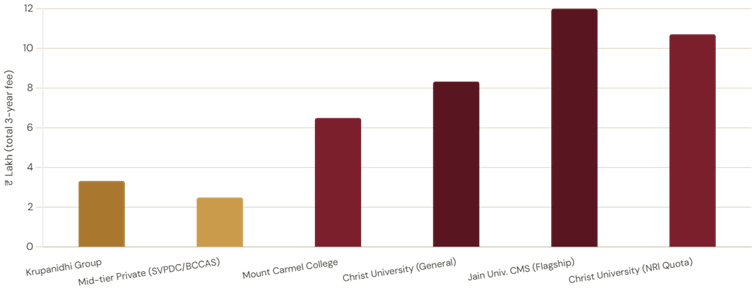
Christ University sits at the more expensive end of the accessible tier. The university’s released 2026 BBA fee structure puts the total academic fee at ₹8.33 lakh, comprising ₹8.25 lakh in tuition and ₹8,000 in other charges, with ₹2.83 lakh payable in the first year and an additional ₹50,000 hostel fee. That marks a rise of roughly ₹1.05 lakh over the 2025 fee of ₹7.28 lakh — a year-on-year increase of about 14 percent. NRI-quota applicants face a steeper total of ₹10.71 lakh for the same programme. Separately, counselling sources tracking the management-quota track specifically cite a narrower annual range of ₹4.5 lakh to ₹7 lakh or more for Christ’s management quota BBA seats, inclusive of tuition, library, and exam fees — a figure that should be read as an unverified estimate from a third-party admissions consultancy rather than an official university disclosure.
Jain University’s BBA fee picture is the most fragmented of any college in this briefing, largely because of how many specialisations it runs. One widely cited range puts the regular-route fee at ₹2.8 lakh to ₹4.15 lakh per year, while a 2026–27 fee aggregator instead lists the total 3-year BBA fee between ₹6.75 lakh and ₹16 lakh depending on specialisation and any bundled professional certification, and Jain’s Center for Management Studies separately quotes its flagship BBA fee at ₹12 lakh for the full duration, up from ₹8.95 lakh in 2025–26 — a roughly 34 percent jump in a single year. Management-quota seats specifically can run to ₹18 lakh or more at the top end. The honest reading: Jain’s BBA fee depends enormously on which specialisation and campus a student targets, and the headline “starting from” figures quoted by counselling sites routinely understate what the popular, globally-tied specialisations (ACCA-UK, US CMA) actually cost.
Mount Carmel College is comparatively the most transparent and the most consistent across sources. The total course fee for MCC’s flagship BBA programme is reported between ₹6.01 lakh and ₹7.04 lakh, depending on specialisation, a figure corroborated almost to the rupee by a separate fee-structure listing. At the lower end of the citywide spectrum, Krupanidhi Group of Institutions comes in at roughly ₹3.33 lakh total — making it one of the more economical options among colleges that still carry meaningful brand recognition in Bangalore’s BBA circuit.
Placements: Where the Real Differentiation Lies
Fee comparisons only tell half the story. The number that should weigh more heavily on a direct-admission decision is what happens at the other end of three years — and here, the picture across Bangalore’s BBA colleges is more uneven than fee tables suggest. It’s also worth flagging plainly that most BBA colleges in Bangalore do not officially release placement data, meaning much of what circulates is sourced from student reviews rather than verified institutional disclosures. Treat every figure below with that caveat in mind.
Reported Placement Packages by College (₹ LPA)
Highest vs. average package reported for recent BBA graduating batches
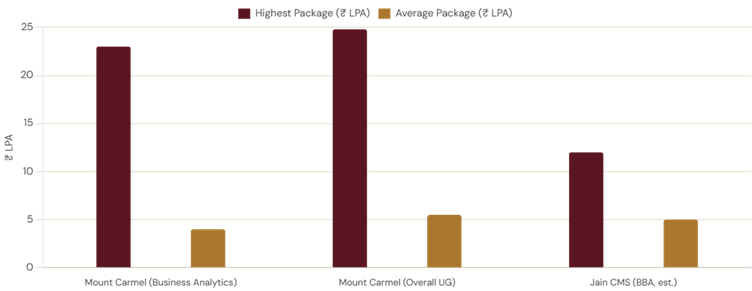
Mount Carmel’s numbers illustrate the gap between headline and median outcomes well. For its BBA business analytics track specifically, 70 percent of students reported being placed, with the highest package at ₹23 LPA, the lowest at ₹3 LPA, and an average around ₹4 LPA — recruiters cited included JP Morgan, Deloitte, Amazon, IBM, Wipro, and Infosys. Across the wider UG batch, the 2024 figures showed a highest package of ₹14 LPA against an average of ₹4.33 LPA. A separate placement report pegs the picture slightly differently: a highest package of ₹24.8 LPA against an average of ₹5.5 LPA and a median of ₹4.8 LPA, with recruiters including Accenture, Capgemini, Cognizant, Cisco, Citibank, and TCS. The pattern across both sources is consistent even where the exact numbers differ: a small number of outlier offers pull the “highest package” figure well above what a typical graduate should expect.
Jain University’s strength shows up more clearly on the engineering side than on BBA specifically, but the institutional placement machinery is shared across programmes. Over 1,000 companies participated in Jain’s 2025–26 campus drives, resulting in more than 2,500 job offers, with the highest salary package reaching ₹54 LPA and an average of ₹8 LPA — though that average blends across all programmes, not BBA alone. For BBA specifically, fees run mid-to-premium with average packages around ₹4–6 LPA, and meaningfully higher offers reserved for top-performing students.
Christ University’s BBA placement story is harder to verify against a current, official figure. One frequently cited number — a highest package of ₹6.5 LPA — is tied explicitly to a historical 2016 cohort, not a recent batch, and should not be read as representative of 2025 or 2026 outcomes. The same source does note recruiters across years including Goldman Sachs, DE Shaw, Arcesium, EY India, and Deloitte India, which signals the calibre of employer access even if the specific package figure is dated. Prospective applicants should ask Christ’s admissions office directly for the most recent batch’s verified placement report rather than relying on aggregator figures of uncertain vintage.
Admission Process and Timeline
The mechanics of applying differ meaningfully depending on which tier a student targets, but the overall academic-year rhythm is broadly shared across Bangalore’s BBA colleges.
| Timeline | Admission Activity |
| Dec 2025 – Feb 2026 | Fee structures for the 2026–27 academic year are released by major universities. Application portals for entrance-test-based admissions (such as Christ and Jain JET) open in phases. |
| Mar – May 2026 | Entrance tests, group discussions, and personal interviews are conducted for merit-based seats. Management and institutional quota applications generally run simultaneously for eligible students who did not clear or did not appear for the entrance process. |
| Jun – Jul 2026 | Peak admission period for direct and management quota admissions. Seat confirmation, first-installment fee payment, and document verification are typically completed during this phase. Colleges offering rolling admissions based on Class 12 marks continue accepting applications throughout this period. |
| Aug 2026 | Final seat allocation, spot admissions, and late-round admissions take place for institutions with vacant seats. Academic sessions commence for most BBA programmes. |
Documents to Keep Ready
- Class 10 and Class 12 original mark sheets and pass certificates
- Transfer certificate and migration certificate (if moving from another board or state)
- Conduct certificate from the previous institution
- Passport-size photographs (typically 6–8 copies)
- Aadhaar or equivalent government identity proof
- Category certificate, if applying under a reserved category alongside management quota
- NRI/OCI documentation, where applicable, for the NRI quota fee track
Specializations Worth Knowing About
BBA in Bangalore is no longer a single undifferentiated degree. Jain University’s BBA programmes alone span Sports Management, Corporate BBA, and Branding and Advertising, alongside two globally-linked tracks — BBA in Finance and Accounting integrated with the UK’s ACCA qualification, and Strategic Finance paired with the US Certified Management Accountant credential. The latter two are explicitly designed to layer an internationally recognised finance credential on top of the base degree, which is part of why their fees sit well above Jain’s standard BBA track.
At Mount Carmel, the specialisation list runs to Finance, Marketing, Human Resources, International Business, and — per its placement data above — Business Analytics, which has emerged as one of the stronger earners among MCC’s BBA tracks based on the recruiter list attached to it. Students evaluating a management-quota seat at any institution should ask specifically which specialisation the seat is being offered under, since fee, faculty depth, and placement outcomes can vary substantially within a single college depending on the track.
Return on Investment — Reading the Numbers Honestly
Putting fee and placement data side by side produces a more useful picture than either figure alone, even with the caveats already noted about self-reported placement numbers.
Approximate Total Fee vs. Reported Average Package
₹ lakhs (total 3-year fee) against ₹ LPA (average reported package) — illustrative comparison
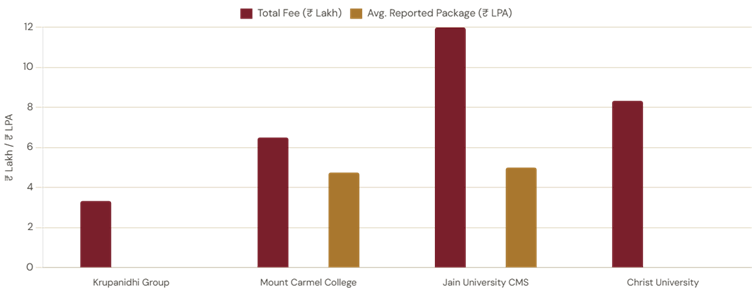
Read this chart as a starting point for questions, not a verdict. A college with a lower total fee and a comparable average package — Mount Carmel against Jain’s flagship CMS track, for instance — represents a stronger arithmetic ROI on paper. But that comparison ignores brand value in recruiter perception, alumni network depth, and the breadth of specialisations on offer, all of which matter over a multi-decade career even if they don’t show up in a fee-versus-package scatter plot. The honest use of this kind of chart is to flag where a fee premium needs to be justified by something beyond the placement number — network access, a specific specialisation, or campus location — rather than to crown a single “best value” college.
| College | Total Fee (₹ Lakh, approx.) | Avg. Package (₹ LPA, reported) | Direct-Entry Route |
| Mount Carmel College | 6.0 – 7.0 | 4.0 – 5.5 | Management quota seats; entrance test for merit track |
| Christ University | 8.3 (general) / 10.7 (NRI) | Not recently disclosed (verify with institution) | CUET-based merit track; quota route disputed — verify directly |
| Jain University (CMS) | 8.95 – 12.0+ (flagship); 6.75 – 16.0 (range) | 4.0 – 6.0 (BBA specific) | JET entrance test; SAT exemption for NRI applicants |
| Krupanidhi Group | ~3.33 | Not independently verified | Predominantly direct, marks-based entry |
| Mid-tier private colleges (SVPDC, BCCAS, PISM) | Under 3.0 | Not independently verified | Direct admission, minimal documentation friction |
Frequently Asked Questions
✅ Is direct admission to BBA legal and recognized by universities?
Yes, where it takes the form of an officially designated management or institutional quota, disclosed by the college itself and confirmed through a written, official offer of admission. It is not legal, and offers no degree-validity protection, when it takes the form of an unofficial capitation payment routed through an unauthorised consultant.
✅ What is the minimum class 12 percentage needed for direct BBA admission in Bangalore?
Most direct-admission colleges in Bangalore set the eligibility floor between 40 and 70 percent aggregate, with 50 percent being the most commonly cited minimum at recognised institutions, regardless of stream studied at the 10+2 level.
✅ Does Christ University offer a genuine management quota seat for BBA?
Sources conflict on this point. Some counselling sites describe an active, fee-graded management quota track; an official-facing FAQ states there is no direct-admission provision and that all BBA seats are filled through the entrance test, micro-presentation, and interview. Given this conflict, verify directly with Christ’s admissions office before relying on any third party’s claim.
✅ How much more does a management quota seat cost compared to a merit seat?
The premium varies by institution and is rarely published transparently. At the upper end, estimates for Christ’s quota seats run to ₹4.5–7 lakh annually against a general fee that, when annualised, is somewhat lower; at Jain, quota-linked estimates run as high as ₹18 lakh for the full course against a stated general range starting near ₹6.75 lakh. Treat any specific quota premium figure as indicative rather than fixed until confirmed by the institution in writing.
✅ Can a science-stream student apply for direct BBA admission?
Yes. Eligibility for BBA direct admission is consistently stream-agnostic — Humanities, Social Sciences, Commerce and Management, and Sciences students are all eligible, provided the class 12 marks threshold is met.
✅ Are placement figures quoted by colleges and aggregators reliable?
Treat them with caution. Most Bangalore BBA colleges do not officially publish audited placement data, and figures circulating online are frequently drawn from student reviews or third-party aggregators rather than verified institutional reports. Ask the college directly for its most recent batch’s median package, not just the highest offer, before making a fee decision based on expected ROI.
✅ Is there an NRI-specific admission route, and does it cost more?
Yes, most major universities run a distinct NRI/OCI fee track. At Christ, this pushes the total BBA fee from roughly ₹8.33 lakh to ₹10.71 lakh. Jain accepts standardised test scores such as the SAT in place of its own entrance exam for eligible NRI applicants.
Read More Blogs-
- Direct Admission in Alliance University | Management Quota
- Direct Admission in Christ University | Management Quota
- Direct Admission in Narsee Monjee | Management Quota
- Direct Admission in SCMS Bangalore
- Direct Admission in SCMS Pune
- BBA at NMIMS – Direct Admission, Management Quota & NRI Seats Available
- SCMS Pune BBA Seats through Management Quota 2026
- BBA Direct Admission- Top Ranked Colleges India
- Top Private BBA Colleges India- Direct Admission
- Top BBA Colleges Accepting Direct Admission India