

India’s economic landscape is transforming at a pace few could have predicted a decade ago — and the professionals who will shape that transformation are being trained in classrooms right now. NMIMS (Narsee Monjee Institute of Management Studies), one of India’s most respected private universities, offers a B.Sc. in Economics that places students at the intersection of rigorous analytical training and real-world policy relevance. For aspirants who did not secure a seat through the regular merit process, the university’s Management Quota and NRI Quota seats offer a direct and legitimate pathway into this coveted programme — no compromise on quality, no compromise on the NMIMS credential.

Why Study Economics — and Why Now?
Economics is no longer the preserve of government planners or dry academic theorists. In the 21st century, it is the operating language of business strategy, public policy, financial markets, technology firms, and international development. Every major consulting firm, every central bank, every fintech startup, every multilateral institution employs economists — people who can model behaviour, read data, anticipate market shifts, and translate complex phenomena into actionable insight.
India, with its trillion-dollar economy, a population of 1.4 billion, and an ambition to become a developed nation by 2047, needs trained economists at every level. The government alone — from NITI Aayog to the Reserve Bank of India to state finance departments — absorbs hundreds of economics graduates every year. Meanwhile, the private sector’s appetite for people who can think quantitatively and reason clearly about incentives and constraints has never been higher.
“We provide admission assistance, guidance, and counseling for students to increase their chances of admission to top colleges and universities in India. Contact Ace Guru Education Services or visit our website- bba-admission.com, or you can send us an email at queries@ace-guru.com, call @ 9742479101, Ankit Mishra.
A B.Sc. in Economics provides precisely that toolkit: microeconomic theory, macroeconomic modelling, econometrics, statistics, game theory, development economics, financial economics, and more. It is a degree that opens doors — to postgraduate study at prestigious Indian and global universities, to careers in banking and finance, to research and public policy, and to entrepreneurship.
The question then is not whether to study economics, but were. And that is where NMIMS makes a compelling case.
NMIMS: An Institution That Needs No Introduction
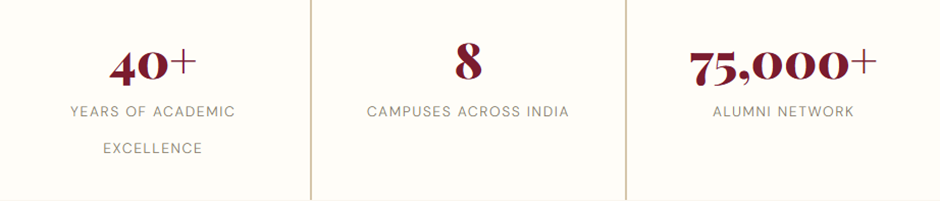
Founded in 1981 and granted deemed university status in 2003, NMIMS has grown from a management institute into a full-fledged multi-disciplinary university with campuses in Mumbai, Bengaluru, Hyderabad, Navi Mumbai, Indore, Chandigarh, Dhule, and Shirpur. It is accredited by NAAC with an ‘A’ grade and is consistently ranked among India’s top private universities by NIRF, QS India, and other major ranking agencies.
What distinguishes NMIMS is its deeply industry-integrated academic model. The university has built strong ties with the corporate sector over four decades, and its alumni network — spanning senior leaders in banking, consulting, technology, and entrepreneurship — is one of its most valuable assets. An NMIMS degree carries weight not merely because of academic rigour, but because of the reputation that precedes every graduate who enters the job market.
The School of Economics, which administers the B.Sc. The Economics programme brings together faculty with doctoral qualifications from premier institutions in India and abroad. The curriculum is designed not merely to teach theory but to develop economists — graduates capable of applying analytical frameworks to actual problems, conducting independent research, and communicating findings clearly.
B.Sc. Economics: Programme Architecture
The B.Sc. Economics at NMIMS is a three-year, six-semester undergraduate programme. It is structured to build from foundational economic concepts in the first year to advanced specialisation and applied work by the third year. The programme is approved by the University Grants Commission (UGC) and conforms to the National Education Policy (NEP) 2020 framework where applicable.
Year One — Foundations
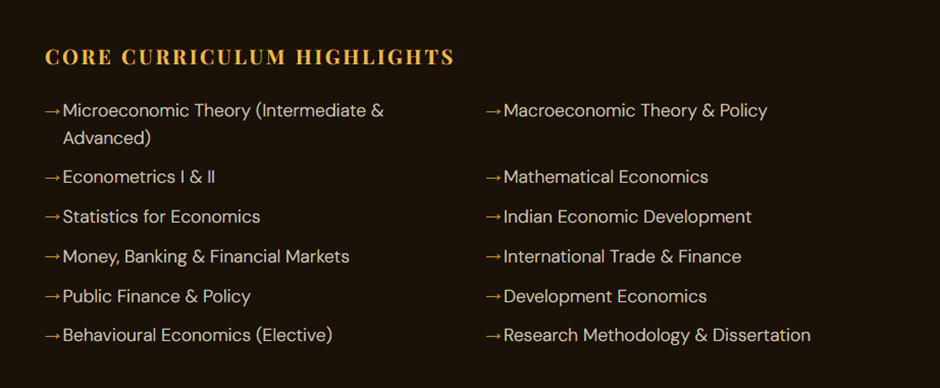
The first year introduces students to the core concepts that underpin all economic reasoning. Subjects typically covered include Principles of Microeconomics, Principles of Macroeconomics, Mathematics for Economics, Statistics I, and Introduction to Indian Economy. Students also undertake humanities and business communication modules to develop their written and oral presentation skills — a critical dimension of professional life that pure technical training can overlook.
Year Two — Intermediate Theory and Methods
The second year deepens theoretical knowledge and introduces quantitative tools. Intermediate Microeconomics examines consumer theory, production theory, market structures, and welfare economics with greater formal rigour. Intermediate Macroeconomics covers national income accounting, monetary theory, IS-LM and AD-AS models, and open economy macroeconomics. Econometrics I introduces students to regression analysis and statistical inference as tools for empirical economic research. Students also study Money, Banking and Financial Markets and Development Economics — a subject of particular relevance for understanding the Indian context.
Year Three — Specialisation and Application
The final year offers elective specialisations, allowing students to customise their academic profile according to their career aspirations. Typical elective tracks include Financial Economics, Public Economics and Policy, International Economics, Behavioural Economics, and Urban and Environmental Economics. A mandatory dissertation or research project in the final semester enables students to demonstrate independent scholarly capability — a requirement for competitive postgraduate programme applications.
Beyond classroom instruction, students are required to participate in industry immersion programmes, guest lectures by senior economists and policy practitioners, inter-university economics competitions, and at least one industry internship. The internship component — typically undertaken between the second and third year — ensures that students enter the final year of study with real workplace experience, making them considerably more employable upon graduation.
Admission Pathways: Merit, Management, and NRI Seats
NMIMS offers admission to the B.Sc. The economics programme has three principal pathways. Understanding each is essential for applicants to identify the route most appropriate for their situation.
The Merit Pathway
The primary admission pathway is through NMIMS’s own entrance examination, commonly referred to as NPAT (NMIMS Programmes After Twelfth). The NPAT is a computer-based test covering Proficiency in English Language, Quantitative and Numerical Ability, and Reasoning and General Intelligence. Candidates who score above the cutoff are shortlisted for merit-based admission. Competition for these seats is intense — NMIMS receives applications from across the country, and the merit cutoff for the Economics programme is typically high.
Management Quota — Direct Admission
A specific percentage of seats in the B.Sc. Economics programmes are reserved under the Management Quota. These seats are available for direct admission and do not require the candidate to have appeared in NPAT or achieved a particular score. Management Quota admission is based on academic eligibility — candidates must have completed their 10+2 (or equivalent) with the required minimum percentage — and is granted on a first-come, first-served basis, subject to seat availability.
Management Quota seats carry the same academic standing as merit seats. Students admitted through this route attend the same classes, sit the same examinations, receive the same degree, and are eligible for the same placement opportunities as their merit-admitted peers. The distinction is only in the admission process, not in the academic experience or the value of the credential.
The fee structure for Management Quota seats is typically higher than merit seats, reflecting the premium nature of direct admission. Prospective applicants should request a detailed fee schedule from the admissions counsellor to understand the full financial commitment involved.
NRI Quota — Direct Admission
The NRI (Non-Resident Indian) Quota is specifically designed for Indian nationals and Persons of Indian Origin (PIOs) who are residing abroad, as well as for candidates whose parents or guardians are NRIs or hold OCI (Overseas Citizen of India) status. It is also available to foreign nationals of Indian origin.
NRI Quota admission follows a streamlined process — eligible candidates can secure a seat without undergoing the NPAT, subject to verification of NRI/OCI/foreign national status and academic eligibility. Fees for NRI Quota seats are quoted in USD and are governed by NMIMS’s international admissions fee schedule.
| Seat Category | Eligibility | Entrance Required | Process |
| Merit / Open | 12th pass, any stream | NPAT (Mandatory) | Merit list-based |
| Management Quota | 12th pass, min. 50–55% | Not Required | Direct admission |
| NRI Quota | NRI / OCI / Foreign National | Not Required | Document verification |
Regardless of the admission pathway, all students are expected to maintain academic standards once enrolled. NMIMS takes academic integrity seriously, and the programme’s rigour ensures that graduation itself is a meaningful achievement — not merely a formality.
Fee Structure for B.Sc. Economics at NMIMS
The fee structure varies based on the admission route:
Regular Admission
- Approx. ₹2.5 – ₹4 lakh per year
Management Quota
- Higher than regular fees
- Can range between ₹4 – ₹7 lakh per year
NRI Quota
- Typically charged in USD
- Approx. $5,000 – $10,000 per year
Note: Fees may vary depending on campus and year.
Eligibility Criteria
The eligibility criteria for B.Sc. Economics at NMIMS is straightforward and designed to ensure that incoming students have sufficient academic preparation for university-level study:
Educational Qualification: Candidates must have passed the Class 12 (10+2) examination or its equivalent from a recognised board. This includes CBSE, ICSE, IB, Cambridge A-Levels, and state boards across India. The programme is open to students from any stream — Arts, Commerce, or Science — though students with a background in Mathematics or Economics at the 10+2 level will find the transition somewhat smoother.
Minimum Aggregate: A minimum aggregate percentage of 50% in the qualifying examination is typically required (some campuses and quota categories may specify slightly different thresholds). For NRI and Management Quota, the academic eligibility standard is the same.
Mathematics: While not always a mandatory requirement for admission, students who have not studied Mathematics at the 10+2 level should be prepared for bridge modules in the first semester, as economics at the undergraduate level — particularly econometrics and mathematical economics — demands quantitative competence.
Appearing Candidates: Students who are appearing in their final 10+2 examinations and awaiting results are eligible to apply. Admission in such cases is provisional and subject to the submission of final mark sheets meeting the eligibility criteria.
Step-by-Step: The Direct Admission Process
For Management Quota and NRI Quota applicants seeking direct admission, the process is considerably more streamlined than the competitive merit route. Here is a typical outline of steps involved:
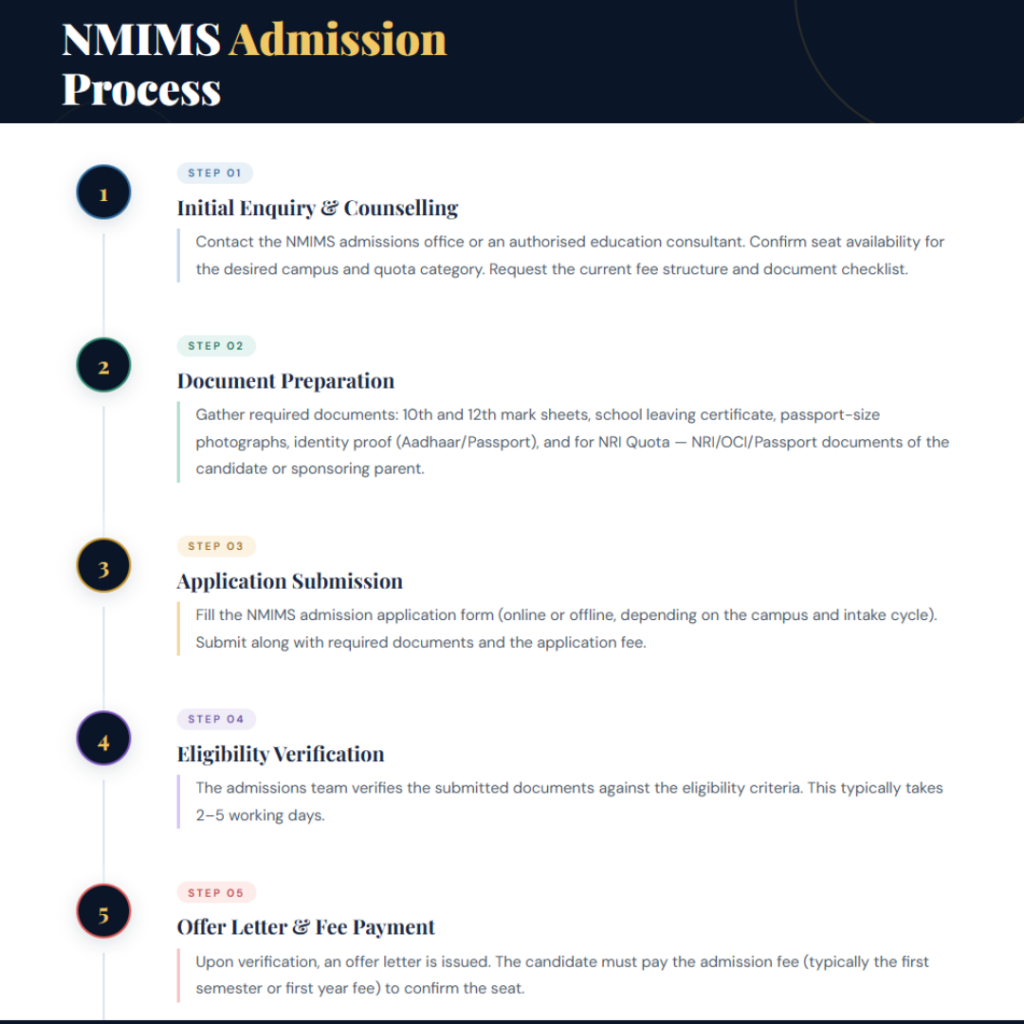
Seats under the Management and NRI Quota are limited and filled on a first-come, first-served basis. Candidates are strongly advised not to delay their application once they have decided to pursue this route, as seats at preferred campuses can be exhausted well before the official deadline.
Career Outcomes: Where Do B.Sc. Economics Graduates Go?
The career pathways available to an economics graduate from NMIMS are genuinely diverse. The programme is designed to produce graduates who are ready either to enter the workforce immediately or to pursue competitive postgraduate programmes in India or abroad.
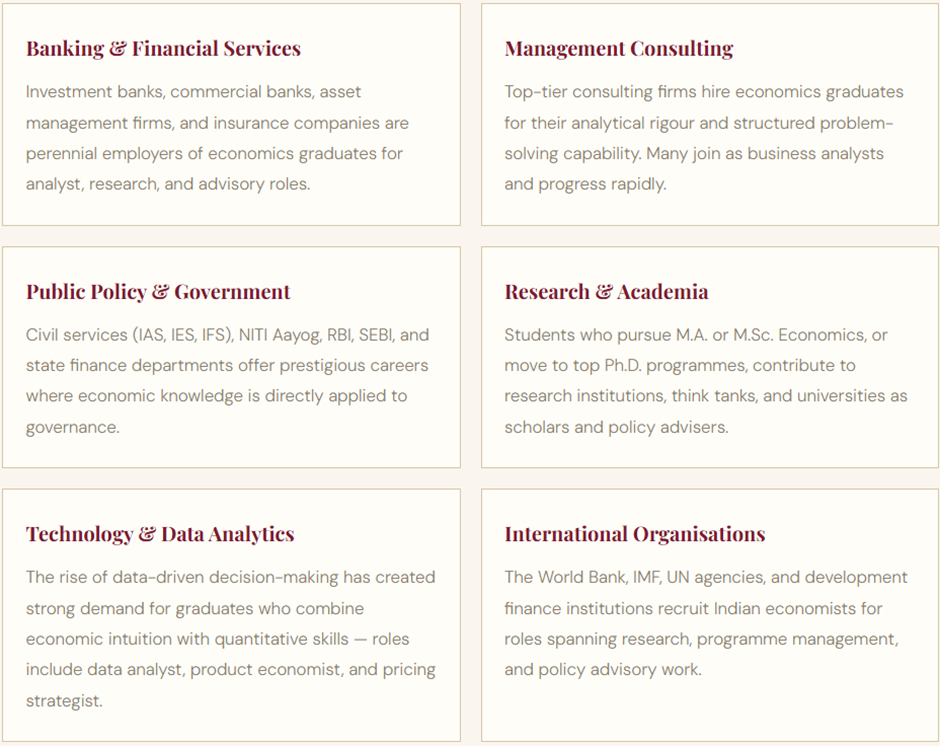
For students who wish to pursue postgraduate study, a B.Sc. Economics from NMIMS provides a strong foundation for M.A. and M.Sc. Economics programmes at institutions such as Delhi School of Economics, JNU, IGIDR, Gokhale Institute, as well as international universities in the UK, USA, Canada, and Australia. NMIMS’s academic reputation and its emphasis on quantitative methods position graduates well for competitive admissions to these programmes.
Comparison: Regular vs Management vs NRI Admission
| Parameter | Regular Admission | Management Quota | NRI Quota |
| Entrance Exam | Required | Not always | Not required |
| Competition | High | Low | Low |
| Fees | Moderate | High | Very High |
| Seat Availability | Limited | Limited | Limited |
| Admission Speed | Slow | Fast | Fast |
Making the Case for Management & NRI Quota: A Realistic Assessment
Some families approach Management and NRI Quota seats with a degree of hesitation, unsure whether they represent genuine value or merely an expensive alternative route. This concern, while understandable, largely misses the point of how such quotas function in India’s private university sector.
The Management Quota exists because private deemed universities are substantially self-financed. The higher fees charged for these seats subsidise infrastructure, faculty salaries, scholarships for meritorious students, and institutional development. In return, students admitted through this route receive access to the full academic, co-curricular, and placement resources of the institution, identically to merit-admitted students.
The degree certificate does not indicate the admission pathway. What it indicates — to every employer and postgraduate admissions committee — is that you studied economics at NMIMS. That credential is what carries weight.”
For families, the relevant calculation is straightforward: if NMIMS’s B.Sc. Economics programme delivers the academic quality, faculty expertise, alumni network, and career outcomes you are seeking, and if a Management or NRI Quota seat secures access to that programme without the uncertainty of competitive examination, then the additional fee premium is the cost of certainty — of knowing that your child’s academic future is secured at an institution you trust.
Preparing for Success: Advice for Incoming Students
Once a seat is secured, the real work begins. NMIMS’s B.Sc. Economics is not a passive degree — it demands active intellectual engagement. Students who thrive are those who approach the programme with curiosity, rigour, and a willingness to be stretched.
A few practical suggestions for incoming students: Strengthen your mathematics foundation before the first semester begins — review calculus, linear algebra, and introductory statistics if your 10+2 background is weak in these areas. Read the financial press (The Economic Times, Mint, The Hindu BusinessLine, The Economist) as a daily habit — connecting classroom theory to current events deepens both learning and motivation. Identify a research interest early — students who know by the second year which sub-field of economics most excites them are better positioned to choose relevant electives, secure targeted internships, and produce stronger dissertations.
Network actively with seniors, faculty, and alumni. NMIMS’s alumni community is genuinely accessible and often willing to mentor students who make proactive contact. A single meaningful conversation with an alumnus working in your field of interest can open doors that no textbook can.
Finally — engage with the campus ecosystem. Inter-university competitions, economics societies, research seminars, and industry events are where learning is consolidated and where professional identity begins to form. A NMIMS degree is what you make of it; the institution provides the platform, but the student must step onto it.
“We provide admission assistance, guidance, and counseling for students to increase their chances of admission to top colleges and universities in India. Contact Ace Guru Education Services or visit our website- bba-admission.com, or you can send us an email at queries@ace-guru.com, call @ 9742479101, Ankit Mishra.
Read More Blogs:
- Top B-tech Colleges Metro Cities Pune with Management Quota & Direct Admission
- Top B-tech Colleges Metro Cities in Mumbai with Management Quota & Direct Admission
- Dehradun to Bangalore– Get B-Tech Direct Admission Top Engineering Colleges
- Top Engineering Colleges Bangalore for Direct B-Tech Admission without High KCET or COMEDK
- Management Quota Fees Top Engineering Colleges Bangalore
- BMS College of Engineering Direct Admission
- MBBS Direct Admission Fee [MQ & NRI Seat]
- MBBS Management Quota Fees in Karnataka
- — B-Tech Admission Through Management Quota
- — B.Tech Colleges in Bengaluru for Direct Admission
- — BMS College of Engineering Management Quota Fees:
- — Direct Admission BMS College
- — Direct Admission MIT Manipal
- — Direct Admission MS Ramaiah Institute of Technology
- — Direct Admission RV College
- — Direct Admission SRM Chennai
- — New Horizon College of Engineering Management Quota Fees
- — PES University Management Quota Fees
- — RV College of Engineering Management Quota Fees
- CMR Institute of Technology Management Quota Fees
- Dayananda Sagar College of Engineering Management Quota Fees
- Manipal Institute of Technology Direct Admission
- MS Ramaiah Institute of Technology Management Quota Fees & Process
- RNS Institute of Technology Management Quota Fees
- MBA Direct Admission in Bangalore MBA Colleges
- Direct Admission in Karnataka Medical Colleges
- What is RV College Management Quota Fees
- RV College of Engineering Management Quota
- JJM Medical College Direct MBBS Admission
- MGM Aurangabad Direct MBBS Admission
- Management Quota in Engineering Colleges for NRIs
- BMS College of Engineering Direct Admission
- Direct Admission in PES University
- BITS PILANI Management Quota Admission
- — How to Get Direct Admission in PICT Pune – Complete Guide
- Top Engineering Colleges for B.Tech Direct Admission in Bangalore
- Direct Admission PES University
- Get Direct Management Quota BBA Admission in Symbiosis
- Narsee Monjee MBA Management Quota
- Direct Admission Symbiosis Pune Management Quota Seats for MBA & BBA
- PICT Pune Direct Admission Management Quota