

Christ University is one of India’s most prestigious private universities, known for its academic excellence, disciplined campus environment, and strong placement record. Located primarily in Bangalore, with multiple campuses across India, the university attracts thousands of applicants every year for its undergraduate and postgraduate programs.
Among its most popular programs is the Bachelor of Business Administration (BBA), along with courses in commerce, law, psychology, and management. Due to the high demand and limited number of seats, many students and parents explore alternative admission routes, including the management quota.
This article provides a detailed, transparent, and practical guide to Christ University management quota admission, including eligibility, process, fees, risks, and expert advice.
Christ University, nestled in the heart of Bangalore, Karnataka, is one of India’s most prestigious private universities. Established in 1969 as Christ College and later granted deemed university status, it has grown into a comprehensive institution that attracts students from across the country and abroad. Its NAAC A++ accreditation — the highest possible grade from India’s National Assessment and Accreditation Council — places it in an elite category of Indian universities committed to academic excellence.
Located on Hosur Road, the university’s primary campus spans a lush, green environment that students and faculty alike describe as calm, eco-conscious, and conducive to learning. The university currently operates across multiple campuses including Central (Bangalore), Delhi NCR, Pune, Kengeri, and Yeshwanthpur. However, when students and parents speak of the coveted BBA programme, they almost always mean the flagship Central Campus in Bangalore.
Christ University is particularly famed for its commerce and management courses. The BBA programme here consistently ranks among the top in India and is a dream destination for thousands of students who aspire for a quality management education at the undergraduate level. The university was historically ranked No. 1 for BBA by India Today for three consecutive years (2013, 2014, 2015), and continues to maintain a top-4 position nationally.
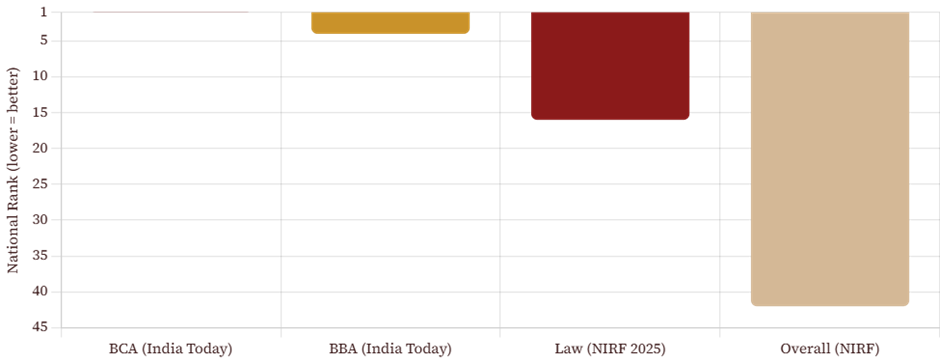
The Bachelor of Business Administration (BBA) at Christ University is a 3-year, full-time undergraduate programme offered by the School of Business and Management. It is designed for students who wish to develop a strong foundation in management, commerce, and entrepreneurship before pursuing higher studies like an MBA or entering the workforce as junior executives.
The programme stands out because of its rigorous curriculum, mandatory internships (one with an NGO and one with a corporate firm), strong alumni network, and excellent placement record. Students are exposed to real-world business challenges through case studies, industry visits, guest lectures, and live projects.
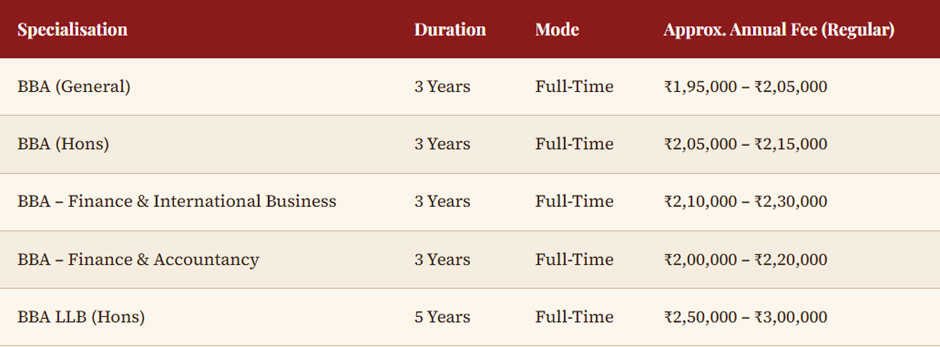
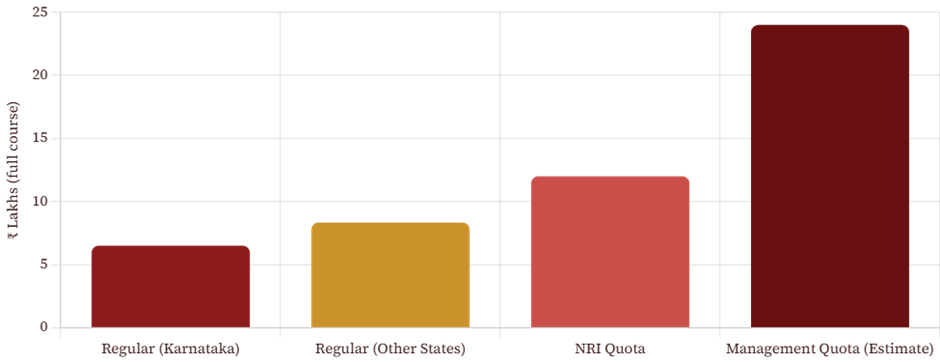
Across all specialisations, the total BBA fee for 3 years (regular merit quota) is approximately ₹5.15 lakh to ₹8.33 lakh, exclusive of hostel and miscellaneous expenses. The total academic fee for 2026-27 has been placed at ₹8.33 lakh for the full course.
Did You Know? Approximately 80% of registered BBA students at Christ University secure job offers through campus placements. Students are eligible for placements from the 5th semester, provided they maintain a minimum 60% academic score.
Understanding the merit-based regular admission process is essential before appreciating why the management quota exists and who benefits from it. Christ University conducts its own entrance exam called the Christ University Entrance Test (ET-CU), often referred to as CUET in the local context. This is not to be confused with the national-level Common University Entrance Test (CUET) run by the NTA.
Applications open in the second week of December each year and close around late April. The application fee is ₹1,500 per campus. Students must register on the official portal at christuniversity.in and submit their academic credentials.
The entrance exam is conducted in multiple sessions (typically 3-4 sessions between January and May). The exam is computer-based and covers six sections:
| Section | Topics Covered |
| English Language | Reading Comprehension, Vocabulary, Grammar, Idioms |
| General Knowledge & Current Affairs | National/International events, Business news |
| Quantitative Aptitude / Mathematics | Arithmetic, Algebra, Data Interpretation |
| Critical / Analytical / Logical Reasoning | Puzzles, Sequences, Deductive reasoning |
| Fundamental Accounting | Basic Accounting principles (Commerce stream) |
| Numerical Ability | Computation, Estimation, Percentages |
Shortlisted candidates are invited to appear in person for a Skill Assessment Test and a Micro Presentation. The micro presentation typically requires students to speak for 1-2 minutes on a business or social topic, testing communication skills, confidence, and analytical thinking.
The final round is a personal interview where a panel of faculty members evaluates the candidate’s motivation, awareness of current events, career goals, and suitability for the programme.
The management quota (also called institutional quota or discretionary quota) is a provision under which private universities and colleges can fill a fixed percentage of their total seats through a process that is less strictly tied to entrance exam rankings. This is a legal and common practice across private universities in India, particularly in Karnataka, which has a well-established regulatory framework for private higher education.
The management quota typically accounts for 15–25% of the total seats in a programme, with the remaining seats filled through the merit (regular) route. The specific percentage varies depending on government regulations and university policy.
Private universities are largely self-financed. The management quota allows them to generate additional revenue that helps maintain infrastructure, pay faculty, and cross-subsidize scholarships for meritorious students. In return, students who gain admission through this route pay a significantly higher fee.
It is important to note that Christ University itself does not officially advertise or encourage admission through third-party management quota consultants. Many consultancy agencies claim they can secure management quota seats at Christ University — students are strongly advised to deal directly with the university’s official admission office to avoid fraud.
There is often confusion between the NRI Quota and the Management Quota. The NRI (Non-Resident Indian) quota is specifically for Indian students residing abroad or students of NRI families, and typically involves fees quoted in USD or a fixed rupee equivalent. The NRI fee at Christ University for BBA programmes ranges from approximately ₹2,80,000 to USD 5,200 per year. Management quota, on the other hand, is broader and applies to Indian domestic students as well.
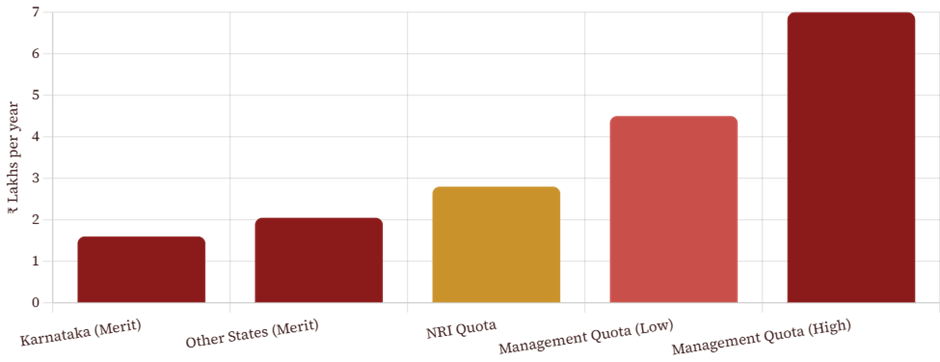
The most significant differentiator between the regular admission route and the management quota route is the cost. Management quota seats command a substantially higher fee, often 2-3 times the regular tuition, plus a potential additional donation or capitation amount.
| Fee Component | Amount (Approx.) | Frequency |
| Application / Registration Fee | ₹1,500 | One-time (non-refundable) |
| Admission Registration (on offer) | ₹8,000 | One-time (non-refundable) |
| Tuition Fee (Karnataka Students) | ~₹1,60,000 | Per year |
| Tuition Fee (Other States) | ~₹1,95,000 – ₹2,05,000 | Per year |
| NRI Students | ~₹2,80,000 – ₹3,00,000 | Per year |
| Hostel Fee (if applicable) | ₹1,00,000 – ₹1,50,000 | Per year |
| Library, Lab & Other Charges | ₹20,000 – ₹40,000 | Per year |
| Total 3-Year Regular BBA (approx.) | ₹5.15L – ₹8.33L | Full course |
| Fee Component | Amount (Approx.) | Frequency |
| Application / Consultancy Fee | ₹5,000 | One-time |
| Enhanced Tuition (Management Quota) | ₹4,50,000 – ₹7,00,000 | Per year |
| Donation / Capitation (if applicable) | ₹2,00,000 – ₹5,00,000+ | One-time (varies) |
| Hostel Fee | ₹1,00,000 – ₹1,50,000 | Per year |
| Library, Lab & Other Charges | ₹20,000 – ₹40,000 | Per year |
| Total 3-Year Estimated Cost (MQ) | ₹18L – ₹30L+ | Full course |
While the process varies based on seat availability and university policy, here is a general roadmap for students seeking BBA admission at Christ University through the management or discretionary quota route:
| Step No. | Admission Process Step | Details |
|---|---|---|
| 1 | Visit Official Admission Portal | Start at Christ University official website. Avoid third-party agents. Contact the official admissions helpline for management quota details. |
| 2 | Pay Application & Registration Fee | Pay a non-refundable application fee of ₹1,500 per campus. After selection, an additional ₹8,000 registration fee is required. |
| 3 | Submit Academic Documents | Provide 10th & 12th mark sheets, transfer certificate, character certificate, category certificate (if applicable), and passport-size photographs. International students must submit additional documents. |
| 4 | Appear for Entrance Test (ET-CU) | Appearing for the entrance test is recommended or may be mandatory, even for management quota. Conducted between January and May in multiple sessions. |
| 5 | Skill Assessment & Interview | Candidates must undergo Skill Assessment Test, Micro Presentation, and Personal Interview conducted on campus. |
| 6 | Receive Offer of Admission | Selected candidates receive an Offer of Admission Card. Fee payment must be completed within 5 working days or as per the offer instructions. |
| 7 | Fee Payment & Enrolment | Pay full first-year fee, including higher tuition/donation for management quota. Always collect official receipts. |
| 8 | Orientation & Classes | After completing enrolment, attend orientation and begin classes at the university. |
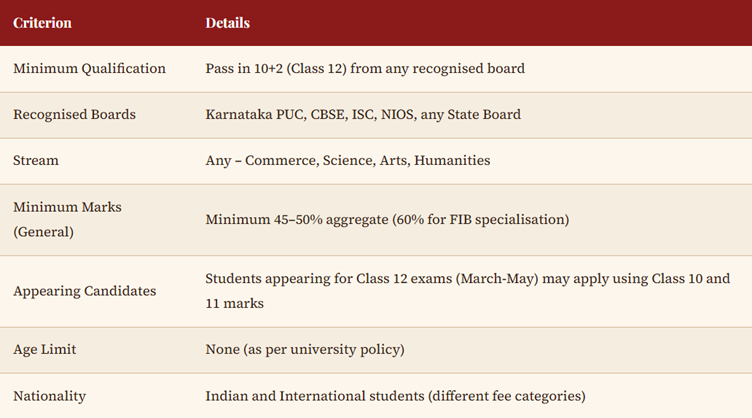
Whether applying through the regular merit route or the management quota, the basic eligibility criteria remain the same. Christ University does not have an age limit for BBA applicants.
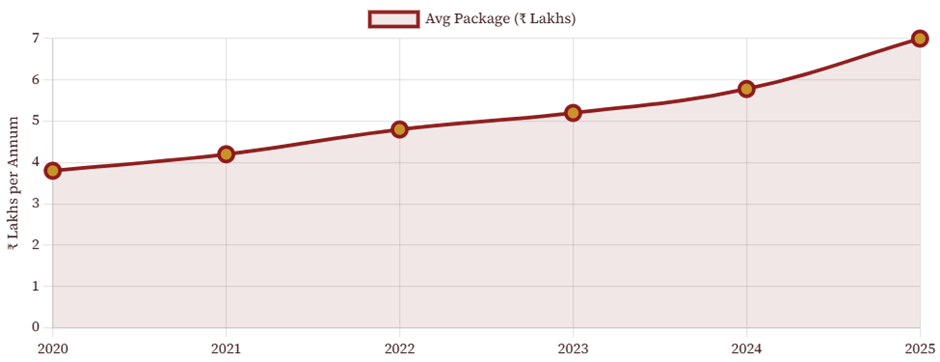
One of the primary reasons students and parents are willing to pay a premium for a Christ University BBA seat — whether through regular or management quota — is the institution’s excellent placement record.
Christ University’s placement cell attracts some of the country’s most reputed companies. Top recruiters for BBA graduates include Dell, Aditya Birla Group, Mercedes Benz, Wells Fargo, ICICI Bank, Deloitte, Bosch, Oracle, and Infosys, among many others. The MBA programme’s recruiters have shown a 23.7% growth in packages over the past two years.
Focus especially on English Language, Logical Reasoning, and General Knowledge. Commerce students should brush up on Fundamental Accounting. Practice mock tests available on preparation platforms.
Practice speaking on a variety of topics for 1-2 minutes. Focus on structure: open with a hook, cover 2-3 key points, close with a clear stance. Confidence and clarity matter more than perfection.
Applications open in December. Applying in the first two weeks increases your chances of getting a preferred exam date and session. Seats tend to fill faster in later sessions.
Always approach Christ University’s official Admissions Office at christuniversity.in. The university’s official process and any additional fee structures will be communicated through proper channels.
Dozens of consultants claim they can secure a management quota seat at Christ University for a fixed fee. Many are fraudulent. Verify any consultancy firm’s legitimacy and never pay upfront fees to third parties without official documentation.
Christ University offers merit scholarships based on academic performance — some students receive up to ₹15,000 per year in fee refunds. Sports scholarships and financial aid for economically weaker students are also available. Explore these before opting for the management quota route.
Ensure every fee paid is officially receipted. Do not pay any amount — especially donations or capitation fees — in cash without receiving an official university receipt. Keep copies of all correspondence.
Christ University’s official position is that admissions are merit-based and transparent through the ET-CU process. The university does not officially market a “management quota” per se. However, like all private universities in India, it has a discretionary quota for a portion of seats, the details of which must be obtained directly from the university.
The general minimum is passing 10+2 with approximately 45-50% marks in any stream. For specific programmes like BBA Finance and International Business, a minimum of 60% in 12th grade is required. However, the final admission depends on the complete selection process, not just marks.
Yes. Christ University accepts students from all streams — Arts, Commerce, Science, and Humanities — for the BBA programme. No specific stream restriction applies. However, the entrance test includes a Fundamental Accounting section, which Commerce students may find easier.
Based on available information, the university’s selection process — including the entrance test, skill assessment, micro presentation, and personal interview — applies to all applicants. The management quota may allow flexibility in cutoff scores but does not bypass the selection rounds entirely.
Yes. Christ University offers Merit Scholarships annually in September, based on academic performance across entrance exams, mid-semester tests, and attendance. Scholarships are offered as a percentage refund of fees. Financial aid for economically weaker students and sports scholarships are also available. The university also facilitates access to state government and external scholarship schemes.
The NRI (Non-Resident Indian) quota is specifically for NRI students or children of NRIs, with fees typically quoted in USD or a higher rupee equivalent (approximately ₹2,80,000 – USD 5,200 per year). The management quota is a broader institutional discretionary quota applicable to domestic Indian students as well.
Yes. Christ University conducts multiple sessions of its entrance test (usually 3-4 between January and May). Students who receive their 12th-grade results in March-May can apply in later sessions. However, seats in high-demand programmes may be limited in the final sessions.
Christ University offers hostel facilities with an application fee of ₹300. Annual hostel costs (including mess charges) typically range from ₹1,00,000 to ₹1,50,000 per year. The hostel application is separate from the course admission process.
Also Read: